
Handmade Folk Art 1972 Wood GM&O Railroad Locomotive Caboose Lamp Set Vintage
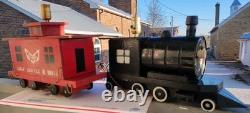
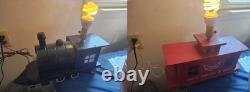
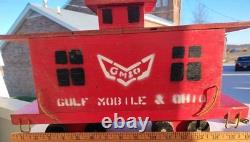
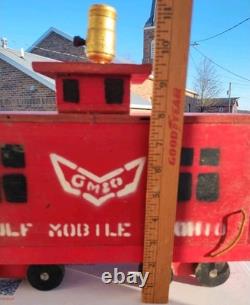
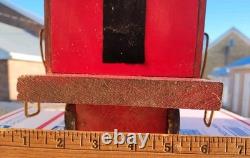
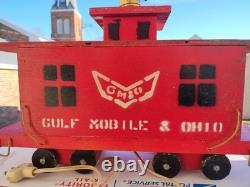
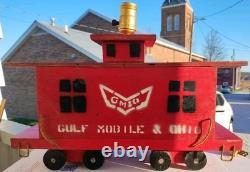
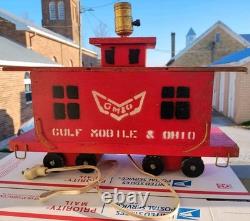
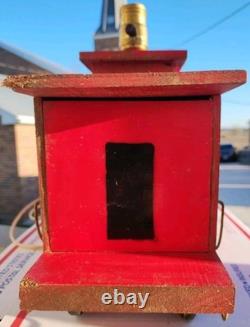
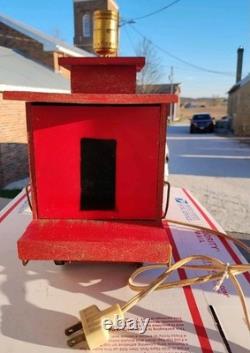
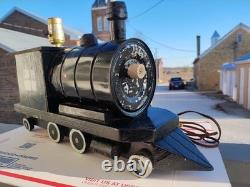
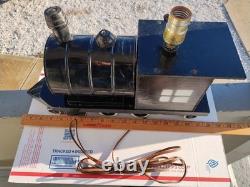
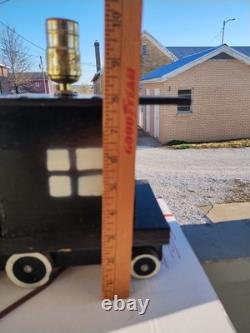
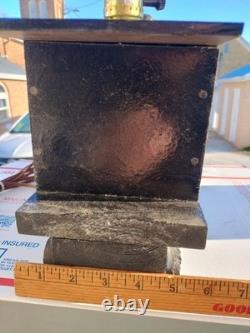
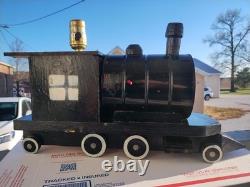
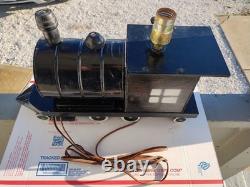
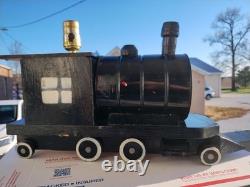
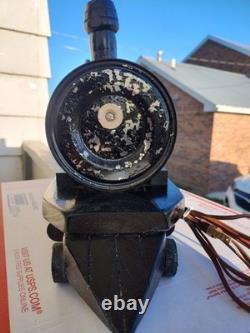
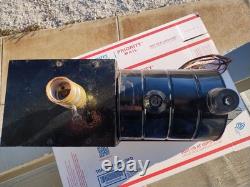
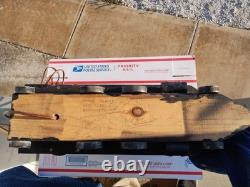
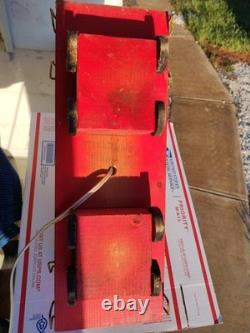
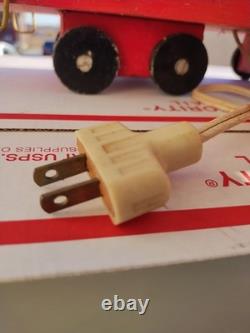

Look at pictures for condition and measurements. Purchasing means you acknowledge this. Other items listed and remember to follow, so you don't miss out on new listings. More items listed and are being listed.
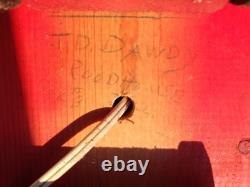
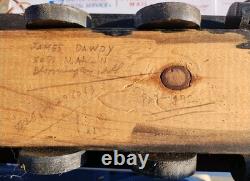
Handmade Folk Art 1972 Wood GM&O Railroad Locomotive Caboose Lamp Set Vintage&####128308;&####128992;&####128993;&####128308;? I bought these some years ago in the Jerseyville area. They're both signed by James D Dawdy. The train has Bloomington, IL with 1972 written on the bottom with the signature and the caboose has Roodhouse, IL written on the bottom with the signature.
My understanding is that he made the train first and then the caboose later on after moving to Roodhouse. From what I could find there was a James Douglas Dawdy (1936 - 2008) that lived in Roodhouse. This handmade folk art wooden GM&O Railroad Locomotive Caboose Lamp Set from 1972 is a vintage collectible piece originating from the United States. The colorful design and unique craftsmanship make it a standout piece for collectors interested in railroadiana and trains.Perfect for adding a touch of nostalgia and charm to any space, these lamps are sure to be a conversation starter for enthusiasts of vintage hardware and lanterns. The Gulf, Mobile and Ohio (reporting mark GMO) was a Class I railroad in the central United States whose primary routes extended from Mobile, Alabama, and New Orleans, Louisiana, to St.
Louis and Kansas City, Missouri, as well as Chicago, Illinois. From its two parallel lines through eastern Mississippi, the GM&O also served Montgomery and Birmingham, Alabama, as well as Memphis, Tennessee. Gulf, Mobile and Ohio Railroad. Gulf, Mobile and Northern Railroad; Alton Railroad. 2 in (1,435 mm) standard gauge. The Gulf, Mobile and Ohio terminal in Mobile, Alabama. The Gulf, Mobile and Northern Railroad was created as the reorganization of the New Orleans, Mobile and Chicago Railroad in 1917. The GM&O was incorporated in 1938 to merge the Gulf, Mobile and Northern Railroad and the Mobile and Ohio Railroad, which was accomplished in 1940. The GM&O later bought and merged the Alton Railroad in 1947. Tigrett, a native of Jackson, Tennessee, was president of the GM&N from 1920 and of the GM&O from 1938 to 1952, and oversaw the development of the road from a nearly bankrupt operation into a thriving success. He was the great-uncle of Hard Rock Cafe founder Isaac Tigrett, also a native of Jackson. From 1952 to 1972 the headquarters of the GM&O were in Mobile, Alabama at 104 St. The President of the GM&O Railroad during this period was Glen Porter Brock, Sr. The Railroad retained the passenger terminal at Beauregard Street for additional offices. At the end of 1944 GM&O operated 1950 miles of road, including NOGN; at the end of 1950 it operated 2898 route-miles.The GM&O Railroad was the first "large" railroad in the United States to replace all its steam locomotives with diesels. On August 10, 1972 the Gulf, Mobile and Ohio Railroad merged into the Illinois Central Railroad, forming the 9600-mile north-south Illinois Central Gulf Railroad. In 1988, the railroad dropped the "Gulf" from its name, reverting its name to the Illinois Central Railroad. In 1996 Illinois Central spun off some of its redundant trackage, including most of the former Gulf, Mobile and Ohio. Most of this trackage was acquired by other railroads.
1940 depicting one of the Rebel streamliners. Streamliner circa 1940s between Chicago and St. Louis thereafter, the railroad also operated other named trains including. Alton Limited (later simply The Limited): Chicago - St.Abraham Lincoln: Chicago - St. Ann Rutledge: Chicago - St.
Gulf Coast Rebel: originally Mobile - Union, Mississippi, later extended to St. Midnight Special: Chicago - St. Gulf, Mobile and Ohio caboose #2825 is on display in Kiroli Park in West Monroe, Louisiana.Gulf, Mobile and Ohio caboose #2867 is privately owned and on display in Rienzi, Mississippi. Gulf, Mobile and Ohio caboose #2951 is on display in downtown Madison, Mississippi. Gulf, Mobile and Ohio caboose #2954: re-numbered by ICG as #199044, preserved by the Monticello Railway Museum in Monticello, Illinois.
Gulf, Mobile and Ohio caboose #2994 is on display at the depot in downtown Corinth, Mississippi. Gulf, Mobile and Ohio caboose #2997 is on display at the depot in downtown Booneville, Mississippi.
Gulf, Mobile and Ohio SD40 #950: the first SD40, currently in Illinois Central marking as #6071, donated to the Monticello Railway Museum in Monticello, Illinois. Gulf, Mobile and Ohio GP35 #631 currently owned by the SARM in Oak Ridge, Tennessee. The unit is non-operational and in much disrepair. Gulf, Mobile & Ohio parlor-observation #5998 from the 1935 "Abraham Lincoln" train is on display at the Museum of Transportation in St. Gulf, Mobile & Ohio EMD AA Boxcab #1200 is currently on display at the Museum of Transportation in St. Louis, Missouri as B&O 50. Gulf, Mobile, & Ohio ALCO RS1 #1053 is currently preserved at the Danbury Railroad Museum in Danbury, Connecticut as New Haven #0673. Gulf, Mobile and Ohio Pullman "Judge Milton Brown" is on display and used by American Family Radio at the Casey Jones Village in Jackson, Tennessee.Gulf, Mobile and Ohio #580, originally Gulf, Mobile and Northern #425, is currently operational at the Blue Mountain and Reading Railroad in Port Clinton, Pennsylvania. Gulf, Mobile and Ohio F3 #800A is currently inoperable on display as the Seaboard Air line #4033 at the Gold Coast Railroad Museum, in Miami, Florida.
Gulf, Mobile and Ohio F3 #883A which was later rebuilt and converted into an FP10 by MBTA and renumbered to #1153 is currently on display at the Edaville Railroad, in South Carver, Massachusetts. Gulf, Mobile and Ohio Azalea Passenger car located in Liberty, New Jersey 1421 US-46 visible on Google Maps. Sonny Boy Williamson recorded the song GM&O Blues in 1945. A GM&O EMD E7 and passenger cars were featured in the 1967 film In the Heat of the Night. In popular music, the GM&O line is referenced in Adrian Belew's "The Rail Song, " a nostalgic song about the heyday and subsequent decline of the American railroads. Originally on 1983's Twang Bar King album, the song can also be found on the Desire of the Rhino King compilation and in an acoustic version on both The Acoustic Adrian Belew and the Salad Days compilation.The album cover of the 1989 Traveling Wilburys song End of the Line features an upside down photograph of the Ann Rutledge at Lincoln, Illinois in 1953. Rebels, lightweight streamlined trains, built for GM&O predecessor GM&N by American Car and Foundry. The only locomotive built by Ingalls Shipbuilding, the Ingalls 4-S, was operated by the GM&O. "Maps of GM&O and predecessor lines". Archived from the original on 2010-09-11.
Louis Gateway Rail: The 1970s, Arcadia Publishing, 2006, p. "The GM&O In Pop Culture".
Archived from the original on 2014-05-08. The Gulf, Mobile & Ohio Historical Society. The Gulf, Mobile and Ohio (book).The GM&O Historical Society, Inc. Archived from the original on 2007-03-14. James Childers Railroad Collection, McLean County Museum of History.
Steve Gossard Railroad Collection Archived 2018-03-03 at the Wayback Machine, McLean County Museum of History. Last edited 1 day ago by FloridaArmy. Gulf, Mobile and Northern Railroad. Ripley and New Albany Railroad. Shortline railroad in Mississippi, United States.
The Gulf, Mobile and Northern Railroad (reporting mark GMN) was a railroad in the Southern United States. The first World War had forced government operation upon the company; and in 1919, when it became once more a free agent, it chose Isaac B. Tigrett to chart its new course. Tigrett, a native of Jackson, Tennessee, was president of the GM&N from 1920 and of its successor, the GM&O, from 1938 to 1952, and oversaw the development of the road from a nearly bankrupt operation into a thriving success.New Orleans, Mobile and Chicago Railroad, New Orleans Great Northern Railroad. 827 miles (1,331 km) in 1940. On September 13, 1940, the GM&N was merged with the Mobile and Ohio Railroad to form the Gulf, Mobile and Ohio Railroad. Rebel, lightweight streamline trains, built for the GM&N, by ACF. List of defunct Alabama railroads.
List of defunct Kentucky railroads. List of defunct Louisiana railroads. List of defunct Mississippi railroads. List of defunct Tennessee railroads. Railroad Magazine, January 1945, Vol. The Historical Guide to North American Railroads. Milwaukee, Wisconsin: Kalmbach Publishing Company. This article about a Class I railroad in the United States is a stub. You can help Wikipedia by adding missing information. Last edited 10 months ago by Otr500. Defunct railroad in the Southern U. Mobile, Jackson and Kansas City Railroad. The Mobile and Ohio Railroad (M&O) was a railroad in the Southern U.The M&O was chartered in January and February 1848 by the states of Alabama, Kentucky, Mississippi, and Tennessee. It was planned to span the distance between the seaport of Mobile, Alabama and the Ohio River near Cairo, Illinois. [1] On September 13, 1940, it was merged with the Gulf, Mobile and Northern Railroad to form the Gulf, Mobile and Ohio Railroad. System map of the Mobile & Ohio in 1903. 5 ft (1,524 mm) until 1885.
The Mobile and Ohio Railroad was conceived after hard times in Mobile following the Panic of 1837. The port was not generating the business that it had before the panic and businessmen and citizens in the city were inspired with a plan for a railroad to restore commerce to the city. The first section of track opened for service in 1852 between Mobile and Citronelle, Alabama and was constructed in 5 ft (1,524 mm) gauge. The line made it to Columbus, Kentucky on April 22, 1861, steamboats were then used to connect with the Illinois Central Railroad at Cairo. 1848 map showing the planned route of the Mobile and Ohio Railroad.
Share of the Mobile & Ohio Railroad Company, issued 29 November 1886. The start of the Civil War shortly after the completion of the line saw it converted to military use and it quickly became a military target for both sides during the war.It was placed in receivership in 1875 and did not emerge until eight years later. By 1870 the operators saw the need to complete the line all the way to Cairo and make it the northern terminus instead of Columbus, but financial problems stood in the way.
Finally on May 1, 1882, the extension to Cairo was opened. The company then acquired the St. Louis and Cairo Railroad, which was narrow gauge. They converted it to 4 ft 8+1? 2 in (1,435 mm) standard gauge and had a line from Mobile to St.The entire railroad was converted to standard gauge in 1885[4][5] - a year prior to the massive conversion of the other southern railroads. In 1896 the company decided to build a line from its Columbus, Mississippi, terminal toward Florida. On June 30, 1898, the Tuscaloosa to Montgomery line opened in Alabama, along with two short branch lines.
That same year they decided to build a 39-mile (63 km) line from Mobile to Alabama Port and Bayou La Batre, naming it the Mobile and Bay Shore Railway. It was completed in 1899. A merger of the two was attempted in 1902 but vetoed by Mississippi governor James K. Thereafter the M&O continued operations under Southern's control.
On June 3, 1932, the M&O went into receivership again. Southern was accused of having violated the Clayton Antitrust Act by using the M&O for its own profit at the expense of the M&O, though the case was dropped in 1933. The GM&N was then combined with the M&O to form the Gulf, Mobile and Ohio Railroad. List of defunct Illinois railroads. List of defunct Missouri railroads. The Gulf, Mobile and Ohio."GM&O Family Tree Flow Chart". Confederate Railroads - Mobile & Ohio. "Change of Gauge of Mobile & Ohio Railroad". Retrieved July 25, 2025 - via Newspapers. "The Mobile and Ohio Change of Gauge".
Wikimedia Commons has media related to Mobile and Ohio Railroad. Railway line in the United States of America. The Alton Railroad (reporting mark A) was the final name of a railroad linking Chicago to Alton, Illinois; St. Louis, Missouri; and Kansas City, Missouri. On May 31, 1947, the Alton Railroad was merged into the Gulf, Mobile and Ohio Railroad.
Jacob Bunn had been one of the founding reorganizers of the Chicago & Alton Railroad Company during the 1860s. Chicago and Alton Railroad system as of 1918, including the Toledo, St. Louis and Western Railroad (Clover Leaf) in orange, parent of the Alton until 1921. Louis and Kansas City, Missouri. 1847 (Alton and Sangamon Railroad)-1947. Main lines included Chicago to St.Louis and a branch to Kansas City. [2] The former is now part of Union Pacific, with Metra Heritage Corridor commuter rail service north of Joliet (owned by the Canadian National Railway but used by UP). Today, the Kansas City line is part of the CPKC system. The earliest ancestor to the Alton Railroad was the Alton and Sangamon Railroad, chartered February 27, 1847, in Illinois to connect the Mississippi River town of Alton to the state capital at Springfield in Sangamon County. [3] The line was finished in 1852 with the first locomotive trip from Alton to Springfield on September 9, 1852.
[3] The Chicago and Mississippi Railroad extended to Bloomington in 1854 and Joliet in 1855. Initially trains ran over the completed Chicago and Rock Island Railroad to Chicago. Chicago and Alton coal hopper.
Gold Bond of the Chicago and Alton Railroad Company, issued 1. The Joliet and Chicago Railroad was chartered February 15, 1855, and opened in 1856, continuing north and northeast from Joliet to downtown Chicago. It was leased by the Chicago and Mississippi, providing a continuous railroad from Alton to Chicago. In 1857 the C&M was reorganized as the St.
Louis, Alton and Chicago Railroad, and another reorganization on October 10, 1862, produced the Chicago and Alton Railroad. The C&A chartered the Alton and St. Louis Railroad to extend the line to East St. Louis, opened in 1864, giving it a line from Chicago to East St. The city of Bloomington, Illinois was the headquarters and primary repair site beginning in the 1850s.
The repair shops for locomotives and rolling stock were located on the west side of the city between Seminary and Chestnut Streets. These were made of wood and burned in 1867. In 1883 the shops were substantially rebuilt on 40 acres of new land with 15 stone buildings. At that time the shops concentrated mainly on car repairs, but in 1905 they were expanded to accommodate major repairs and rebuilding of locomotives.At the peak of operations in the 1920s the shops employed 2,000 people. Same numbers for 1944 were 2596, 483, 959 and 1717.
By 1950, all of the Alton's steam locomotives were replaced by diesel locomotives. This section may be in need of reorganization to comply with Wikipedia's layout guidelines. 1997-present Gateway Western is a Kansas City Southern Railway subsidiary. Union Pacific Railroad 1996-present Chicago-St. Louis, Alton and Chicago Railroad c. Alton and Sangamon Railroad 1847-c. Postcard depiction of the railroad's Bloomington shops. The first sleeping car designed by George Pullman was built in the C&A's Bloomington shops and introduced on September 1, 1859, on the Chicago-St. Sleeping cars were operated over most routes between Chicago, Peoria, Bloomington, St. Louis and Kansas City in principal train consists. Successor Gulf, Mobile & Ohio operated Chicago-St.Louis sleeping car service until December 31, 1969, the last railroad to do so between the two cities. The first dining car, the Delmonico, named for the famous New York restaurant, was built by Pullman in the Aurora, Illinois, shops of the Chicago, Burlington & Quincy.
The car first appeared in regular service over the C&A's Chicago-St. Two other Pullman diners built at the same time, the Tremont, and the Southern, were leased, providing dining car service on all three principal C&A Chicago-St. Dining cars were a part of Chicago-St. Louis train consists until May 1, 1971, with the takeover of passenger service by Amtrak.
In 1932 the Alton was the first Chicago-St. Louis Railroad to install air conditioning on its passenger trains. First entry of C&A passenger trains from Joliet into Chicago was over the Chicago & Rock Island to that railroad's depot (later La Salle Street Station).Briefly, passenger trains were moved over to the Illinois Central depot. On December 28, 1863, the leased J&C and Pittsburgh, Fort Wayne and Chicago Railway came to an agreement where the J&C would use the PFW&C's terminal at Madison Street, later becoming a tenant of Union Station, which opened in 1881. In 1924, with the completion of a new Union Station between Adams and Jackson streets, C&A became a tenant and its successors used Union Station until the takeover by Amtrak.
Remaining stations built by the Chicago and Alton are located in Independence, Higginsville, and Marshall, Missouri. Presidents of the Alton Railroad have included. This list is incomplete; you can help by adding missing items. Railway Equipment and Publication Company, The Official Railway Equipment Register, June 1917, p.Poor's Intermediate Manual of Railroads, 1917, p. "An Excursion into the Early History of the Chicago and Alton Railroad". Journal of the Illinois State Historical Society.
University of Illinois Press: 7-37. The Chicago and Alton Railroad: The Only Way (2002). The Back Shop Illustrated, Volume 2: Midwest Region (2023). Chicago and Alton Railroad, Annual Reports. Friends of the Chicago & Alton Depot.The Chicago & Alton Railroad, The Only Way. DeKalb, Illinois: Northern Illinois University Press. PRR Chronology Archived 2006-09-07 at the Wayback Machine. Encyclopedia of the History of Missouri - Chicago & Alton Railway (1901). The historical guide to North American railroads 2nd ed.
Alton Railroad - Pantagraph (Bloomington, IL newspaper). Chicago and Alton Railroad Collection - McLean Country Museum of History archives. Steve Gossard Railroad Collection, McLean County Museum of History. United Brotherhood of Carpenters and Joiners America archives (Local Union 377 Alton Chapter) - Special Collections and University Archives at the University of Maryland. Chicago, Missouri and Western Railway. Railroad in the midwestern United States. The Illinois Central Railroad (reporting mark IC), sometimes called the Main Line of Mid-America, is a railroad in the Central United States. Its primary routes connected Chicago, Illinois, with New Orleans, Louisiana, and Mobile, Alabama, and thus, the Great Lakes to the Gulf of Mexico. Another line connected Chicago west to Sioux City, Iowa (1870), while smaller branches reached Omaha, Nebraska (1899) from Fort Dodge, Iowa, and Sioux Falls, South Dakota (1887), from Cherokee, Iowa.The IC also ran service to Miami, Florida, on trackage owned by other railroads. Combined route map of the Chicago Central and Pacific (red) and Illinois Central (blue) railroads in 1996. Two Illinois Central EMD SD70s lead a train at Homewood, Illinois.
Midwest to Gulf Coast, United States. 1851-present Remains a non-operational subsidiary. 5 ft (1,524 mm). 3,130.21 mi (5,037.58 km). The IC, founded in 1851, pioneered the financing later used by several long distance U.
Railroads whose construction was partially financed through a federal land grant. In 1998, the Canadian National Railway, via Grand Trunk Corporation, acquired control of the IC, and absorbed its operations the following year. The Illinois Central Railroad maintains its corporate existence as a non-operating subsidiary.
In 1971, Steve Goodman released a folk anthem, "City of New Orleans" about riding on Illinois Central's "Monday-morning rail" train and the passing of the "magic carpet" ride of passenger rail service in the United States, which once dominated travel. The first land grant railroad. The IC was one of the oldest Class I railroads in the United States.The company was incorporated by the Illinois General Assembly on January 16, 1836. [4] Within a few months Rep.
Zadok Casey (D-Illinois) introduced a bill in the U. House of Representatives authorizing a land grant to the company to construct a line from the mouth of the Ohio River to Chicago and on to Galena. [5] Federal support, however, was not approved until 1850, when U.
President Millard Fillmore signed a land grant for the construction of the railroad. [6] The Illinois Central was the first land-grant railroad in the United States. Illinois Central Rail Road share, issued 1899. The Illinois Central was chartered by the Illinois General Assembly on February 10, 1851. Douglas and later President Abraham Lincoln were both Illinois Central men who lobbied for it.
Douglas owned land near the terminal in Chicago. Lincoln was a lawyer for the railroad.
Illinois legislators appointed Samuel D. Lockwood, recently retired from the Illinois Supreme Court (who may have given both lawyers the oral examination before admitting them to the Illinois bar), as a trustee on the new railroad's board to guard the public's interest.
Lockwood, who would serve more than two decades until his death, had overseen federal land monies shortly after Illinois' statehood, then helped oversee early construction of the recently completed Illinois and Michigan Canal. Upon its completion in 1856, the IC was the longest railroad in the world. Its main line went from Cairo, Illinois, at the southern tip of the state, to Galena, in the northwest corner. A branch line went from Centralia (named for the railroad), to the rapidly growing city of Chicago. In Chicago, its tracks were laid along the shore of Lake Michigan and on an offshore causeway downtown, but land-filling and natural deposition have moved the present-day shore to the east. Track from Centralia north to Freeport would be abandoned in the 1980s, as traffic to Galena was routed via Chicago. During the Civil War Chicago became the supply base for the Western armies.General Ulysses S Grant took his forces on the Illinois Central-his supply line-down to Cairo. He then he marched south to seize control of Kentucky and Tennessee on his way to victories at Shiloh, Vicksburg, and Chattanooga.
In 1867, the Illinois Central extended its track into Iowa. During the 1870s and 1880s, the IC acquired and expanded railroads in the southern United States. IC lines crisscrossed the state of Mississippi and went as far south as New Orleans, Louisiana, and east to Louisville, Kentucky. In the 1880s, northern lines were built to Dodgeville, Wisconsin; Sioux Falls, South Dakota; and Omaha, Nebraska.
Further expansion continued into the early twentieth century. The Illinois Central, and the other "Harriman lines" owned by E. Harriman by the twentieth century, became the target of the Illinois Central shopmen's strike of 1911.
Although marked by violence and sabotage in the southern, midwestern, and western states, the strike was effectively over in a few months. The railroads simply hired replacements, among them African-American strikebreakers, and withstood diminishing union pressure. The strike was eventually called off in 1915. IC (incl Y&MV, G&SI)Vicksburg, Shreveport, & PacificAlabama & Vicksburg.19337,776(into Y&MV)(into Y&MV). IC (incl Y&MV, G&SI)Vicksburg Shreveport & PacificAlabama & Vicksburg. 1933547(into Y&MV)(into Y&MV). The totals above do not include the Waterloo RR, Batesville Southwestern, Peabody Short Line or CofG and its subsidiaries. On December 31, 1925, IC/Y&MV/G&SI operated 6,562 route-miles on 11,030 miles of track; A&V and VS&P added 330 route-miles and 491 track-miles.
At the end of 1970, IC operated 6,761 miles of road and 11,159 of track. In 1960, the railroad retired its last steam locomotive, 2-8-2 Mikado #1518. On August 31, 1962, the railroad was incorporated as Illinois Central Industries, Inc. ICI acquired Abex Corporation formerly American Brake Shoe and Foundry Co. Illinois Central Gulf Railroad Logo. ICG hopper with ACI plate. On August 10, 1972, the Illinois Central Railroad merged with the Gulf, Mobile and Ohio Railroad to form the Illinois Central Gulf Railroad (reporting mark ICG).October 30 of that year saw the Illinois Central Gulf commuter rail crash, the company's deadliest. Later in that decade, the railroad spun off most of its east-west lines and many of its redundant north-south lines, including much of the former GM&O. Most of these lines were bought by other railroads, including entirely new railroads such as the Chicago, Missouri and Western Railway; Paducah and Louisville Railway; Chicago Central and Pacific Railroad; and MidSouth Rail Corporation. In 1988, the railroad's parent company, IC Industries, spun off its remaining rail assets and changed its name to Whitman Corporation. [12] On February 29, 1988, the newly separated ICG dropped the "Gulf" from its name and again became the Illinois Central Railroad.
Integration of operations began July 1, 1999. In November 2020, as part of celebrations for the 25th anniversary of CN's privatization, the company unveiled a series of locomotives repainted in the schemes of the company's predecessor and subsidiary railroads.3008, which was repainted in the black livery of IC, along with the logos of that company. An IC steam locomotive taking on coal at a Chicago rail yard in November 1942. IC 1234, an EMD SW9, switching at Tuscola, Illinois in 1966. A preserved Illinois Central EMD GP11 locomotive on static display in downtown Carbondale, Illinois.
IC 3115, an EMD GP40R, sitting in Waukesha, Wisconsin. Illinois Central 1850 planned Route Map.Illinois Central 1892 Route Map. Illinois Central was the major carrier of passengers on its Chicago-to-New Orleans mainline and between Chicago and St. IC also ran passengers on its Chicago-to-Omaha line, though it was never among the top performers on this route. Illinois Central's largest passenger terminal, Central Station, stood at 12th Street east of Michigan Avenue in Chicago. Due to the railroad's north-south route from the Gulf of Mexico to the Great Lakes, Illinois Central passenger trains were one means of transport during the African American Great Migration of the 1920s.
Illinois Central's most famous train was the Panama Limited, a premier all-Pullman car service between Chicago and New Orleans, with a section breaking off at Carbondale to serve St. In 1949, it added a daytime all-coach companion, the City of New Orleans, which operated with a St. Louis section breaking off at Carbondale and a Louisville section breaking off at Fulton, Kentucky. In 1967, due to losses incurred by the operation of the train, the Illinois Central combined the Panama Limited with a coach-only train called the Magnolia Star. On May 1, 1971, Amtrak took over intercity rail service.
It retained service over the IC mainline, but dropped the Panama Limited in favor of the City of New Orleans. However, since it did not connect with any other trains in either New Orleans or Chicago, Amtrak moved the route to an overnight schedule and brought back the Panama Limited name. However, it restored the City of New Orleans name in 1981, while retaining the overnight schedule. This was to capitalize on the popularity of a song about the train, called City of New Orleans (song) written by Steve Goodman and performed by Arlo Guthrie.
Willie Nelson's recording of the song was #1 on the Hot Country Charts in 1984. Illinois Central ran several other trains along the main route including The Creole and The Louisiane. The Green Diamond was the Illinois Central's premier train between Chicago, Springfield and St. Other important trains included the Hawkeye which ran daily between Chicago and Sioux City and the City of Miami eventually running every other day between Chicago and Miami via the Atlantic Coast Line, the Central of Georgia Railroad and Florida East Coast Railway.
The Illinois Central was also a major operator of commuter trains in the Chicago area, operating what eventually became the "IC Electric" line from Randolph Street Terminal in downtown Chicago to the southeast suburbs. It still operates out of what is now Millennium Station, which is still called "Randolph Street Terminal" by many longtime Chicago-area residents. In honor of the Panama Limited, the Electric District appears as "Panama Orange" on Metra system maps and timetables. Additionally, the IC operated a second commuter line out of Chicago (the West Line) which served Chicago's western suburbs. Unlike the electrified commuter service, the West Line did not generate much traffic and was eliminated in 1931.
Amtrak presently runs three trains daily over this route, the City of New Orleans and the Illini and Saluki between Chicago and Carbondale. Another Illinois corridor service is planned for the former Black Hawk route between Chicago, Rockford and Dubuque. Amtrak, at the state of Illinois' request, did a feasibility study to reinstate the Black Hawk route to Rockford and Dubuque. On December 10, 2010, IDOT announced the route choice for the resumption of service to begin in 2014 going over mostly CN railway. The City of New Orleans at Champaign, IL station on October 27, 1962. IC's City of New Orleans at Kankakee, Illinois in 1964.City of Miami Chicago Miami. City of New OrleansChicagoNew Orleans. Governor's Special Chicago Springfield, Illinois. Hawkeye Chicago Sioux City, Iowa/Sioux Falls, South Dakota. Iowan Chicago Sioux City, Iowa.
Cobb Louisville, Kentucky Memphis, Tennessee. Kentucky Cardinal Louisville, Kentucky Memphis, Tennessee.
Northeastern LimitedShreveport, LouisianaMeridian, Mississippi with continuing sleepers to New York City on the Southern Railway's Pelican. Southwestern LimitedMeridian, Mississippi with continuing sleepers from New York City on the Southern Railway's PelicanShreveport, Louisiana. Sunchaser (winter only)Chicago and St. Presidents of the Illinois Central Railroad have included. This transport-related list is incomplete; you can help by adding missing items.Sidney Breese, Father of the Illinois Central Railroad. 201 on display at the Illinois Railway Museum.
333 on display at Yazoo and Mississippi Valley Railroad Company Depot. Several locomotives and rolling stock formerly owned and used by Illinois Central are preserved, and many of them reside in parks and museums across the United States.
201, a 2-4-4 suburban tank locomotive that participated in the "Wheels A-Rolling" pageant at the Chicago Railroad Fair, is displayed at Illinois Railway Museum in Union, Illinois. 268, an 0-6-0 switcher, resides in Laurel, Mississippi.
333, an 0-6-0 switcher, and several passenger cars are on display just outside the historic Yazoo and Mississippi Valley Railroad Company Depot in Baton Rouge, Louisiana. 764, a 651 class 2-8-0 "Consolidation", was donated to the National Museum of Transportation in St. 790 is on static display at Steamtown National Historic Site in Scranton, Pennsylvania.1518, a 1500 series 2-8-2 "Mikado", is on static display in Paducah, Kentucky. It was built by the Lima Locomotive Works in 1923. 2500, the first of 2500 class 4-8-2 "Mountain" types, is on static display in the Age of Steam Memorial in Centralia, Illinois. 2542, a 2500 class 4-8-2, is on static display at McComb, Mississippi. 3525, an 0-8-0 switcher, is displayed at Tanglewood Park in Clemmons, North Carolina while painted as a Southern Railway locomotive & was renumbered to 1894.
3706, a 2-6-0 "Mogul", resides at the Illinois Railway Museum. A yard office and a coal-fueling tower remain at the Illinois Central yards in Council Bluffs, Iowa. 8408 GP10 locomotive/IC 9426 caboose static display Homewood, IL. Illinois Central GP11 #8701, along with an IC caboose, preserved on static display at the Carbondale passenger station in Carbondale, Illinois. Illinois Central GP11 #8733 preserved at the Monticello Railway Museum in Monticello, Illinois.
Several pieces of IC rolling stock also reside at the Monticello Railway Museum: IC combine No. 892, IC Day Coaches Nos.
2920, 2855, and 2612, IC Business Car No. 7, IC 10-6 sleeper Nos.3531 "Council Bluffs", IC Dorm-baggage No. 65018, IC bridge crane No. X2000 Idler Flat, IC's No. X4342 and X4352 tenders, IC X9151 Jordan Spreader, and IC cabooses Nos. An Illinois Central caboose and banana car are preserved at the Casey Jones Railroad Museum in Water Valley, Mississippi.
Illinois Central "Wickerliner" in Chicago, Illinois, 1967. An Illinois Central caboose is privately owned and preserved in Raymond, Mississippi at the old train depot in the center of the town. 6071 (Ex-Gulf, Mobile and Ohio) at the Monticello Railway Museum in Monticello, Illinois. Illinois Central Gulf GP8 No. 7738 at the Bluegrass Railroad Museum in Versailles, Kentucky. 1974 Illinois Central Gulf caboose No. 199422 in service as IRM 9422 at the Indiana Railway Museum in French Lick, Indiana. Illinois Central caboose on historic main street in Palestine, Illinois. One Illinois Central Caboose resides in Grayville, Illinois. Former Illinois Central "Highliner" built by Bombardier on the Metra Electric, 2002. 1198 and 1380 "Wickerliner" (built by Pullman 1926) electric commuter cars at Illinois Railway Museum.The original Mississippi Central line was chartered in 1852. Construction of the 255 miles (410 km) 5 ft (1,524 mm) gauge line began in 1853 and was completed in 1860, just prior to the Civil War, from Canton, Mississippi to Jackson, Tennessee. The southern terminus of the line connected to the New Orleans, Jackson and Great Northern Railroad at Canton.
It also connected to the Memphis and Charleston Railroad at Grand Junction, Tennessee and the Mobile and Ohio Railroad at Jackson, Tennessee. The Mississippi Central was the scene of several military actions from 1862 to 1863 and was severely damaged during the fighting. West succeeded in repairing the damage and returning it to operating condition soon after the end of the War. By 1874, interchange traffic with the Illinois Central Railroad was important enough that the IC installed a Nutter hoist at Cairo, Illinois to interchange between its standard gauge equipment broad gauge used by the Mississippi Central. The original Mississippi Central line was merged into the Illinois Central Railroad subsidiary Chicago, St. Mississippi Central Railroad passenger train in Sumrall, Mississippi, early 1900s. A line started in 1897 as the "Pearl and Leaf Rivers Railroad" was built by the J. Newman Lumber Company from Hattiesburg, to Sumrall. In 1904 the name was changed to the Mississippi Central Railroad (reporting mark MSC). In 1906 the Natchez and Eastern Railway was formed to build a rail line from Natchez to Brookhaven. In 1909 this line was absorbed by the Mississippi Central. For a short time during the 1920s, the line operated a service named "The Natchez Route", running trains from Natchez to Mobile, Alabama through trackage agreements with the Gulf, Mobile and Northern Railroad. Edward Turner Jeffery, general manager, Illinois Central Railroad. Billups Neon Crossing Signal A unique railroad crossing signal erected in Grenada, MS. Illinois Central Missouri River Bridge, the world's longest swing bridge when constructed. History of rail transportation in the United States. Railroad land grants in the United States.Illinois Central Corporation 1996 Annual Report. "Writing of'City of New Orleans'". "An Act to Incorporate the Illinois Central Rail Road Company, " Laws of the State of Illinois passed by the Ninth General Assembly at their Second Session... House of Representatives, 24th Congress, 1st Session, Report No. 59 - via Google Books.
Brownson, Howard Gray (1967) [1915]. History of the Illinois Central Railroad to 1870 first reprint ed. 157 - via Google Books. The first land grant ever given by Congress to assist in the construction of a railroad..Steamtown National Historic Site, Illinois Central Railroad number 790. Stover, History of the Illinois Central (1975) pp. ABEX Corporation and asbestos - History. ICI, Pepsi organization OK merger Railway Age January 5, 1970 page 8. Schweitzer, Rene (November 17, 2020).
"CN celebrates 25th anniversary of privatization, unveils heritage locomotives". "Amtrak-Illinois dot feasibility study determines most direct route best for service to Rockford, northwestern Illinois and Dubuque, Iowa" (PDF). "Amtrak Black Hawk Service Restoration Status Updates". Archived from the original on June 18, 2018. Railroad Historical Company, Illinois Central Railroad Company (1900). History of the Illinois Central Railroad Company and Representative Employes By William K. Ackerman, Railroad Historical Company, Illinois Central Railroad Company. "The Management of the Illinois Central Railroad in the 20th Century" (PDF). Chicago and the Illinois Central Railroad. Charleston, South Carolina: Arcadia Publishing. "Harrison succeeds Ed Moyers at IC". "The Last Decade of Illinois Central Steam"."French Lick West Baden & Southern Rwy Caboose 9422 (Indiana Railway Museum)". "Confederate Railroads - History, Maps & Equipment". "The Mississippi Central Railroad Campaign".
Edward Vernon, The Decline in Railroad Construction, Editorial, American Railroad Manual New York, 1874; page li. "A Brief Historical Sketch of the Illinois Central Railroad". Archived from the original on January 11, 2012. 2nd November, 1872, for 10 years: "A Railway Wagon Lifting Machine", The Canadian Patent Office Record, Vol.
1 (March, 1873); page 8. Moody's Transportation Manual (1975), p. "Chapter 1: History of the Illinois Central Railroad Company". In Railroad Historical Company ed.
History of the Illinois Central Railroad Company and representative employes : a history of the growth and development of one of the leading arteries of transportation in the United States, from inception to its present mammoth proportions, together with the biographies of many of the men who have been and are identified with the varied interests of the Illinois Central Railroad. Purdue University, The Management of the Illinois Central Railroad in the 20th Century (PDF).University of Illinois at Urbana-Champaign Archives, Wayne A. MBI Railroad Color History 1st ed.
Chicago and the Illinois Central Railroad (Arcadia, 2007), popular history. Agricultural History 5.2 (1931): 57-76. The Illinois Central Railroad and its Colonization Work (Harvard UP, 1934) excerpt.Illinois Central Railroad (2006), photographs, many in color, with brief text online. History of the Illinois Central Railroad (1975), a standard scholarly history online. The Illinois Central and the Growth of Illinois and Chicago in the 1850s.
Railroad History 159 (1988): 39-50. The Management of the Illinois Central Railroad in the 20th Century.
Business and Economic History (1979): 55-60. Wikimedia Commons has media related to Illinois Central Railroad. STB decision, docket number FD_33556_0 (granting CN control of the IC). Illinois Central Railroad Company Archives at the Newberry Library. Guide to the Illinois Central Gulf Railroad.
Kheel Center for Labor-Management Documentation and Archives, Martin P. Encyclopedia of Chicago "Illinois Central Railroad". Illinois Central Railroad Collection Archived March 18, 2018, at the Wayback Machine, McLean County Museum of History. Simpson, Electrification Project : The Illinois Central Railroad Company Suburban Service at Chicago, Ill. 1909 at the University of Chicago Special Collections Research Center. Last edited 4 days ago by Oknazevad. City of New Orleans (train). Amtrak service between Chicago and New Orleans, US.Electric commuter rail line in Chicago, Illinois, USA. Class of American bi-level electric multiple units. Bloomington is a city in McLean County, Illinois, United States, and its county seat.
The 2020 census showed the city had a population of 78,680, making it the 13th-most populous city in Illinois and the fifth-most populous outside the Chicago metropolitan area. It is adjacent to the town of Normal, and is the more populous of the two principal municipalities of the Bloomington-Normal metropolitan area, which has a population of roughly 170,000. McLean County Courthouse and Square.
Miller Park, Home of Miller Park Zoo. Official logo of Bloomington, Illinois. Interactive map of Bloomington, Illinois.Bloomington is located in IllinoisBloomingtonBloomington. Show map of the United States.
27.24 sq mi (70.56 km2). 27.12 sq mi (70.24 km2). 0.12 sq mi (0.32 km2). 2,901.3/sq mi (1,120.18/km2). Bloomington is 135 miles (217 km) southwest of Chicago and 162 miles (261 km) northeast of St. Bloomington is home to Illinois Wesleyan University and the headquarters for State Farm and Country Financial. Bloomington is also home to the minor league hockey team Bloomington Bison. Looking northwest from the east side of the downtown square, about 1910. The Bloomington area was at the edge of a large grove occupied by the Kickapoo people before the first Euro-American settlers arrived in the early 1820s. Springing from the settlement of Keg Grove, later called Blooming Grove, Bloomington was named as county seat on December 25, 1830, when McLean County was created. When the County of McLean was incorporated, a county seat was established, but the legislation stated the site of Bloomington would be located later. Gavin Quinn, one of the new county's promoters, offered to donate 60 acres (240,000 m2) of his land for the new town.His offer was accepted, and Bloomington was laid out. At this time there were few roads, but rich soils brought new farmers who began commerce by conducting their business in the county. People came from all over to trade and do business at the town's center, known today as Downtown Bloomington, including Abraham Lincoln, who worked as a lawyer in nearby Springfield. Prominent Bloomington resident Jesse W.
Fell, who founded the Bloomington Pantagraph and was most prominent in local real estate, had suggested the Lincoln-Douglas debates in 1854 and played a prominent role in pushing Lincoln to run for president. In 1900, an officer on patrol discovered a fire in a laundry across the street from the old city hall and police station. He sounded an alarm but the fire destroyed most of the downtown, especially the areas north and east of the courthouse. The burnt area was quickly rebuilt from the designs of local architects George Miller and Paul O.Bloomington continued to grow during the first two decades of the 20th century. Most notably, State Farm was founded in June 1922 by retired farmer George J. The 1917 Bloomington Streetcar Strike was a labor dispute starting on May 28, 1917, when Amalgamated Transit Union Local 752 called a strike for union recognition, increased pay, and a shortened workday. It ended in July when the mayor of Bloomington, E. Jones, mediated contract talks between the workers and company from July 6 to 9.
During this, the Illinois National Guard had been stationed outside the courthouse where mediation was occurring, equipped with machine gun emplacements. In 1997, Judy Markowitz was elected as the city's first female and Jewish mayor. During her two terms as mayor, an arena was built in downtown Bloomington and the city's performing arts center began restoration. Bloomington also approved a gay rights ordinance in 2002. In 2021, Mboka Mwilambwe was elected as the city's first black mayor.Bloomington-Normal ranks competitively in Richard Florida's creativity rankings. Most noteworthy is Bloomington-Normal's creative class share of the workforce, which resulted in a No.
The Bloomington Center for the Performing Arts is the centerpiece of the city's Cultural District, which also includes the neighboring McLean County of Arts Center, forthcoming festival park, and creativity center for arts education. The center is also home to over twenty area performing arts ensembles. More than 400 performances and community events take place at the Bloomington Center for the Performing Arts each year. The Illinois Symphony Orchestra performs at the Bloomington Center for the Performing Arts, where it gives five Masterworks concerts, two Pops concerts, and three Chamber Orchestra concerts annually. The McLean County Arts Center is one of the oldest arts organizations in the Midwest, serving Central Illinois for over 130 years.
Each year 12 art exhibitions are held, including the Holiday Treasurers exposition and sale, and the annual Amateur Competition and Exhibition which, for over 70 years, has showcased the best amateur artists in Central Illinois. The Arts Center also sponsors a number of community events, such as the Sugar Creek Arts Festival in Uptown Normal and the Spring Bloom Arts Festival in Bloomington. The Community Players Theater, on Robinhood Lane off of Towanda Avenue, is one of the oldest community theaters completely staffed by volunteers. Opened in 1923, it celebrated its 88th season in 2011. The Castle Theatre first opened in 1916 as a 1,000-seat theater, created by the legendary theater builders Balaban & Katz, original inventors of the classic movie palace.For decades, the property served as one of the area's premier destinations. It presents live music, corporate, public and private events. The Illinois Wesleyan University School of Theatre Arts houses its talent within the Jerome Mirza Theatre at McPherson Hall. Four main stage plays are performed here annually, selected from a playbill including everything from Shakespeare to musicals. McPherson Hall, completed in 1963, is named for IWU's 10th president, Harry W.
McPherson, and contains a 300-seat theater, scene shop, classrooms and other facilities. The Illinois Wesleyan University Westbrook Auditorium serves approximately 200 music majors and several hundred IWU students each year.Several musical performances of all style periods are featured each semester, and most concerts are free with general seating. The Miller Park Outdoor Summer Theatre, an amateur theater group sponsored by the City of Bloomington, performs two major theater productions each year. USA Ballet is an international ballet company. It provides children's workshops and outreach programs, and presents at Illinois Wesleyan University's McPherson Theatre three times a year.
American Passion Play was the oldest continuously performed Passion Play in the United States. Performed each spring at the Bloomington Center for the Performing Arts, the Passion Play was set in Palestine and portrays the life of Christ in its entirety, closing finally after its 100th year running in May 2023. The Illinois Shakespeare Festival includes productions performed in an open-air, Elizabethan-style theatre within historic Ewing Manor each summer.The audience is encouraged to picnic on the grounds before each performance to be entertained by strolling Madrigal singers, jesters, and other entertainers as well as a Green Show performance. The Lincoln's Bloomington Festival is held each July in Downtown Bloomington and features Civil War reenactments, traditional craft demonstrations, children's activities, musical performances, talks and tours. The Spring Bloom Arts Festival is hosted by the McLean County Arts Center in March each year. This indoor fine art festival features over 100 artists representing a wide range of media including woodworking, glass art, sculpture, paintings, prints, photographs and handcrafted jewelry.
The McLean County Fair is billed as the'"Home of the World's Largest County 4-H Fair" taking place each August at the McLean County Fairgrounds in Bloomington. 4-H activities include: livestock shows, a film festival, and exhibits around food, nutrition and health, plant science, engineering and technology, and environment and natural resources. Evening Grandstand Entertainment features tractor pulls and various musical acts. Ewing Manor was designed by Bloomington architect Phil Hooten in the Channel-Norman style favored by the affluent in the post-Victorian period. The surrounding gardens were created by noted landscape architect Jens Jensen, who also designed Springfield's Lincoln Memorial Gardens. The theatre on the grounds play host to the Illinois Shakespeare Festival each summer.The McLean County Museum of History traces its roots back to 1892, the year the McLean County Historical Society was founded. Housed inside the old McLean County Courthouse, the museum features permanent and rotating exhibits that explore the history of Central Illinois. This location is listed on the National Register of Historic Places.
The Miller Park Pavilion & War Memorial was restored in 1977 and dedicated in May 1988. The black granite memorial is surrounded by red sidewalks that list the names of Central Illinois residents killed or missing in action in the Korean and Vietnam battles. The Prairie Aviation Museum has a collection of preserved aircraft on display, including a Bell Sea Cobra, Huey helicopter, and F-14 Tomcat. The Evergreen Memorial Cemetery, also known as the Evergreen Cemetery is the burial site of many notable Bloomington-Normal citizens including members of the Stevenson family.Stevenson I, vice president to Grover Cleveland, and Adlai E. Stevenson II, governor of Illinois.
Ambassador to the United Nations, and twice Democratic candidate for the United States presidency, are both buried there. Also buried there are Stevenson's wife, Letitia Green Stevenson, who was the second National President-General of the Daughters of the American Revolution, and her sister, Julia Green Scott, the seventh National President-General of the Daughters of the American Revolution. Other historical figures buried there include David Davis, friend and mentor to Abraham Lincoln; Charles Radbourn, arguably 19th-century baseball's greatest pitcher; and Dorothy Gage, inspiration for the main character in the Wizard of Oz and niece of author L. The David Davis Mansion offers a glimpse into the life friend and mentor of Abraham Lincoln, David Davis, who was a U.Senator from Illinois and associate justice of the United States Supreme Court. The Davis Mansion, completed in 1872, combines Italianate and Second Empire architectural features and is a model of mid-Victorian style and taste.
His Bloomington home, which remained in the Davis family for three succeeding generations, contains the most modern conveniences of that era: a coal-burning stove, gas lighting and indoor plumbing. The David Davis Mansion is an historic landmark on the National Register of Historic Places.
The former building of the Montefiore synagogue is one of the few Moorish Revival buildings in Illinois and one of the oldest synagogues in the United States. Other historical landmarks listed on the National Register of Historic Places. NOAA Weather Radio station KZZ65 transmits from Bloomington and is licensed to NOAA's National Weather Service Central Illinois Weather Forecast Office at Lincoln, broadcasting on a frequency of 162.525 mHz (channel 6 on most newer weather radios, and most SAME weather radios). The station activates the SAME tone alarm feature and a 1050 Hz tone activating older radios (except for AMBER Alerts, using the SAME feature only) for hazardous weather and non-weather warnings and emergencies, along with selected weather watches, for the Illinois counties of McLean, Tazewell, and Woodford.
The Pantagraph is a local daily newspaper serving Bloomington. Terminal of Central Illinois Regional Airport. Bloomington is serviced by passenger rail, bus service, and several airlines.
Amtrak, from its Bloomington-Normal station, operates five trains in each direction between St. Louis and Chicago each day. The station also serves connecting bus service to Peoria and Amtrak stations in Galesburg and Champaign-Urbana. It is Illinois' third-busiest Amtrak station after Chicago and Champaign-Urbana, servicing about 92,000 passengers in fiscal year 2021.
Greyhound Lines provides service to/from Chicago and St. Burlington Trailways offers service from the Amtrak station and the Greyhound station to/from Peoria, Quad Cities, Illinois/Iowa, Champaign, and Indianapolis. The Central Illinois Regional Airport on Route 9 is served by four airlines (Delta Air Lines, American Eagle, Frontier and Allegiant Air), five rental car agencies, and has direct daily flights to Atlanta (Delta), Chicago (American Eagle), Dallas-Ft. Worth (American Eagle), Detroit (Delta), and Minneapolis/St. Additional service includes nonstop flights to Sanford, Florida (Allegiant) and St. A record 559,481 passengers flew to or from CIRA in 2010. Connect Transit provides local bus service with 13 color-coded fixed routes in the area; a lift-assisted paratransit service called Connect Mobility and a campus shuttle for ISU called Redbird Express.Interstates 39, 55, and 74 intersect at Bloomington, making the city a substantial transportation hub. US Highways 51 and 150 and Illinois State Route 9 also run through Bloomington.
The legendary US 66 once ran directly through the city's downtown and later on a bypass to the east. Main article: List of people from Bloomington, Illinois. Last edited 18 days ago by 636Buster.Town in Illinois, United States. Private college in Bloomington, Illinois, US. Rail trail in Illinois, US. Roodhouse is a city in Greene County, Illinois, United States. The population was 1,578 at the 2020 census.
Location of Roodhouse in Greene County, Illinois. 1.13 sq mi (2.92 km2).
0 sq mi (0.00 km2). 1,400.2/sq mi (540.62/km2).
Roodhouse was founded in the 1850s by John Roodhouse. The community was originally known as "The Crossroads" for its position on two major highways, though it was later renamed for its founder. In 1860, John Rawlins convinced the Chicago and Alton Railway to open a station in the community by promising to secure local funds for the depot and warehouse. The railway built its Louisiana branch from Roodhouse in 1871, and the city became a major junction point, boosting its population and economy.
Roodhouse was legally incorporated as a city in 1880. Passenger railroad service to Roodhouse ended in the 1950s, causing a local economic downturn which persisted over the following decades. The Hotel Roodhouse, the city's only surviving hotel from the railroad era, is listed on the National Register of Historic Places. Roodhouse is located in northern Greene County. Route 67 passes through the center of the city, leading north 22 miles (35 km) to Jacksonville and south 13 miles (21 km) to Carrollton, the Greene County seat.According to the 2021 census gazetteer files, Roodhouse has a total area of 1.13 square miles (2.93 km2), all land. Geological Survey Geographic Names Information System: Roodhouse, Illinois. "National Register of Historic Places Registration Form: Hotel Roodhouse" (PDF). Archived from the original (PDF) on August 19, 2014. City in Illinois, United States.
Village in Illinois, United States. Town in Indiana, United States. Greene County is a county located in the U. According to the 2020 United States census, it has a population of 11,843. Its county seat is Carrollton. Map of Illinois highlighting Greene County. 546 sq mi (1,410 km2).543 sq mi (1,410 km2). 3.3 sq mi (8.5 km2) 0.6%. 21.8/sq mi (8.42/km2).
A notable archaeological area, the Koster Site, has produced evidence of more than 7,000 years of human habitation. Artifacts from the site are displayed at the Center for American Archeology in Kampsville, Illinois. Greene County is named in honor of General Nathanael Greene, a hero of the American Revolutionary War.
In 1821, three years after Illinois became a state, Greene County was established, being carved out of what was previously Madison county and St. Over the course of the next 18 years four more counties were formed out of what was once Greene Country. These include Scott, Morgan, Macoupin and Jersey counties. Like much of southern Illinois the earliest settlers in the county came from Southern states such as North and South Carolina, Virginia, Kentucky, and Tennessee.By the time of the Civil War, 1860, the population of Greene County had grown to 16,093 and 10% of the adult population had been born in the Northeast, 15% were foreign born, 25% were born in Southern states, and almost 50% had been born in the Midwest. Of the population born in the Midwest many could still trace their roots to the South, with almost 80% of them having parents born in a Southern state. Greene County from its creation in 1821 to 1823, including unorganized territory temporarily attached to it. Greene County between 1823 and 1825. Greene between 1825 and 1829.
Greene between 1829 and 1839. Greene in 1839 after the creation of Jersey County reduced Greene to its current size.
According to the US Census Bureau, the county has a total area of 546 square miles (1,410 km2), of which 543 square miles (1,410 km2) is land and 3.3 square miles (8.5 km2) (0.6%) is water. Source: The Weather Channel[8]. In recent years, average temperatures in the county seat of Carrollton have ranged from a low of 16 °F (?
9 °C) in January to a high of 87 °F (31 °C) in July, although a record low of? 32 °C) was recorded in January 1912 and a record high of 113 °F (45 °C) was recorded in July 1934.Average monthly precipitation ranged from 1.60 inches (41 mm) in January to 4.34 inches (110 mm) in May. Two Rivers National Wildlife Refuge (part: Apple Creek Division). The population ranking of the following table is based on the 2020 census of Greene County. Greene County was reliably Democratic from the beginning through 1948; only one Republican Party nominee carried the county vote during that period.
Since then it has usually voted for the Republican presidential nominee (14 of 18 elections). As one of the most northerly "southern" counties in Illinois, Greene County was rock-ribbed Democratic for the seventy years after the Civil War, which it opposed as a "Yankee" war. Not until considerable anti-Catholic sentiment against Al Smith turned many voters to Herbert Hoover did the county support a Republican presidential nominee. However, with the coming of World War II, opposition to American involvement led to gains for Wendell Willkie and Thomas E. Dewey, although apart from the 1960 election - also influenced by Catholicism - Greene was a bellwether county throughout the period from 1928 to 2004.Hillary Clinton's 2016 tally of 21.68 percent of the county's vote is 14.3 percent worse than any Democratic presidential candidate before 2012. [30] As of February 2025, the county is one of 7 that voted to join the state of Indiana.
United States presidential election results for Greene County, Illinois[32]. 18921,96735.16%3,14656.24%4818.60%. 18962,36536.88%3,98362.11%651.01%.19002,13135.53%3,78563.11%811.35%. 19041,95940.14%2,64954.28%2725.57%.
19082,00437.19%3,15958.62%2264.19%. 191283117.04%2,80157.44%1,24425.51%. 19163,40035.60%6,15064.40%00.00%. 19203,68547.96%3,77649.15%2222.89%. 19243,52739.73%4,64852.35%7037.92%.
19284,29951.05%4,07648.40%460.55%. 19322,85730.61%6,34767.99%1311.40%. 19363,91637.14%6,51061.74%1181.12%. 19404,84044.30%6,01555.06%700.64%.19444,26149.70%4,26849.78%450.52%. 19483,63947.09%4,03552.22%530.69%.
19525,01954.96%4,10644.96%70.08%. 19564,71854.57%3,90945.21%190.22%. 19604,48753.78%3,84746.10%100.12%. 19643,12839.55%4,78160.45%00.00%. 19683,94451.17%3,09440.14%6708.69%.
19724,67362.13%2,82437.55%240.32%. 19763,70647.35%4,05751.83%640.82%.
19804,22459.33%2,60736.62%2894.06%. 19844,05760.96%2,56338.51%350.53%. 19883,13650.56%3,02048.69%470.76%. 19922,39134.00%3,16444.99%1,47721.00%. 19962,24537.83%2,73446.07%95516.09%.
20003,12954.26%2,49043.18%1482.57%. 20043,55958.65%2,45740.49%520.86%. 20083,05352.40%2,61944.95%1542.64%. 20123,45161.22%2,02335.89%1632.89%. 20164,14574.22%1,20521.58%2354.21%.
20204,77076.48%1,34921.63%1181.89%. 20244,71977.68%1,22020.08%1362.24%.National Register of Historic Places listings in Greene County, Illinois. The Beginning of the War. Life at Camp Carrollton, January and February, 1862.
The Story of a Common Soldier of Army Life in the Civil War 1st ed. Erie, Kansas: Press of the Erie Record. OCLC 1085327623 - via Internet Archive.
Last edited 24 days ago by CyrusTheMediocre. County in Illinois, United States. Surrounding areas Jerseyville, Grafton, Hardin, Kampsville, Carrollton, Belleville.
Great addition to your Madison County, Greene Country, Calhoun County, or Jersey County collection. Near Jerseyville, Kane, Carrollton, Jacksonville, Bunker Hill, White Hall, Fieldon, Hardin, Kampsville, Batchtown, Brussels, Grafton, Godfrey, Alton, Belleville Illinois.